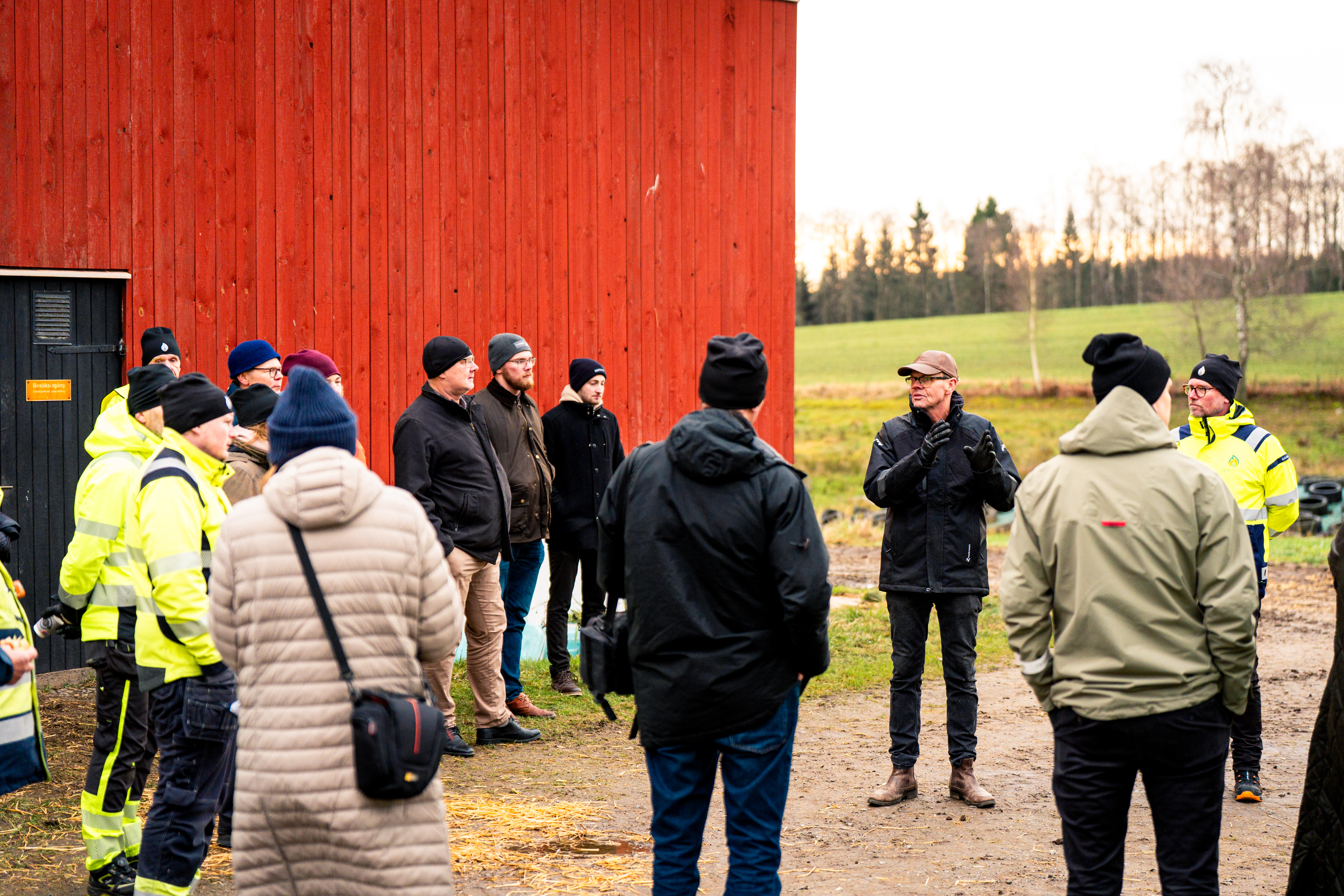
We have produced a series in which, over five Thursdays, you can follow farmer Dan Waldemarsson and hear his thoughts on the following questions:
- Why is the investment in liquid biogas so important for the farm?
- What does upgrading and liquefying the gas involve in practical terms?
- What would it mean if local transport vehicles could refuel from the farm?
- How does Dan view the investment’s significance for the farm’s profitability?
- What is the vision for the future of biogas at farm level?
Biofrigas’ first plant is located at Långhult Farm outside Habo. Farmer Dan has been working with biogas for 15 years and took over the farm from his father in 1987. The farm consists of 350 young bulls, producing 70–80 tonnes of meat per year. The entire farm covers 140 hectares, including leased land, where Dan grows feed for the animals.
The farm’s next development step is to upgrade and liquefy the gas so that it can be used as vehicle fuel. The ambition is, in the long term, to be able to supply heavy goods vehicles in the local area with locally produced liquid biogas. A concrete example of circular and locally produced energy. From manure to the tank, quite simply!
What does the future hold for biogas at farm level?
Dan sees great potential for biogas in the future of agriculture, particularly if the technology for liquefied gas becomes more accessible on a smaller scale. Many farms already have the necessary conditions; what remains is to make the technology and the business model work all the way through.
- What does the future hold for biogas at farm level?
Dan sees great potential for biogas in the future of agriculture, particularly if liquid gas technology becomes more widely available on a smaller scale. Many farms already have the right conditions; what remains is to get the technology and the business model to work seamlessly.
- I’m starting to believe in the idea now! It will be exciting to see the figures as the plant is fine-tuned, he says.
At present, usage is still in the testing phase, but the aim is to create a stable system where the fuel can be sold and used continuously. Theoretical calculations suggest a production rate equivalent to one to two refuelling sessions per day.
Moving forward, much will depend on scale and flow rates, with calculations on how many vehicles can be supplied and how the logistics can work in practice.
Thank you for following this series with us!