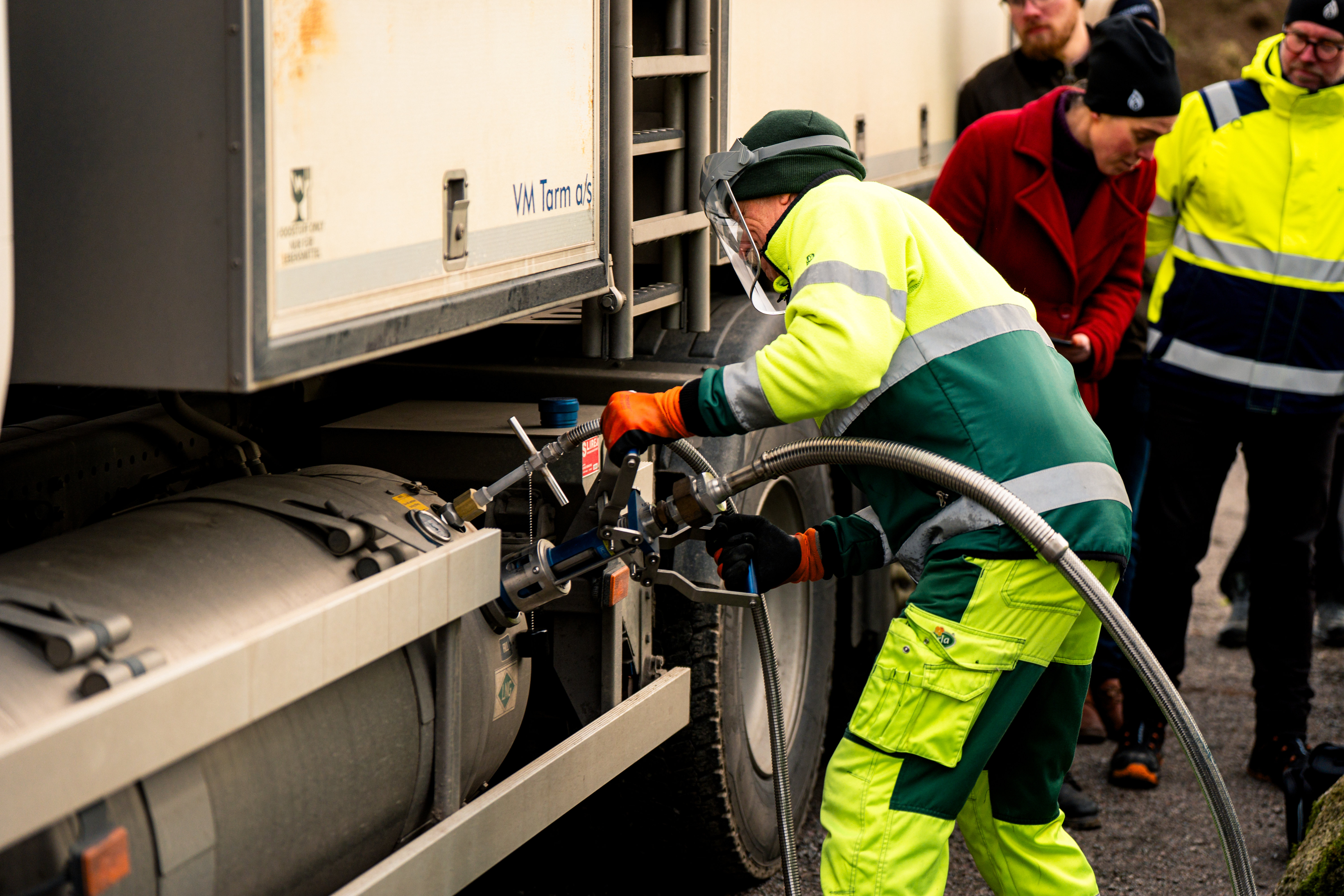
We have produced a series in which, over five Thursdays, you will follow farmer Dan Waldemarsson and hear his thoughts on the following questions:
- Why is the investment in liquid biogas so important for the farm?
- What does upgrading and liquefying the gas involve in practical terms?
- What would it mean if local transport vehicles could refuel from the farm?
- How does Dan view the investment’s significance for the farm’s profitability?
- What is the vision for the future of biogas at farm level?
Biofrigas' first plant is located at Långhult Farm outside Habo. Farmer Dan has been working with biogas for 15 years and took over the farm from his father in 1987. The farm consists of 350 young bulls, producing 70–80 tonnes of meat per year. The entire farm covers 140 hectares, including leased land, where Dan grows feed for the animals.
The farm’s next development step is to upgrade and liquefy the gas so that it can be used as vehicle fuel. The ambition is, in the long term, to be able to supply heavy goods vehicles in the local area with locally produced liquid biogas. A concrete example of circular and locally produced energy. From manure to fuel, quite simply!
What does upgrading and liquefying the gas actually involve in practical terms?
The core of the operation remains unchanged; the digestion process continues as before. The manure is broken down and produces biogas, just as it has done for many years. What is new is that the gas is no longer primarily used in its current form, but is instead upgraded and cooled down to a liquid state.
This presents new technical challenges. When the gas is diverted away from electricity and heat production, the energy balance on the farm is affected, whilst new flows are created.
- We’re removing gas from the flow that previously went to electricity and heat production. So we have to find other solutions, says Dan.
One such challenge is the heat generated when the gas is cooled. It’s there – but at temperatures that are difficult to use effectively.
- It generates quite a lot of heat, but at temperatures that are too low. It’s not entirely straightforward to harness, he says.
At the same time, several questions remain regarding operation and maintenance. How much day-to-day work the plant requires and how self-regulating it can become is not yet entirely clear.
- The big question mark is how much manual intervention is needed and how much maintenance there will be. We won’t know that until we have more operational experience, says Dan.
The facility is still under development, but the direction is clear: to move up the value chain and convert the biogas into a higher-value fuel.
Join us in this series and read next Thursday about Dan’s thoughts on the importance of transport vehicles being able to refuel with locally produced fuel on the farm.